Introduction
Generally having two strikes is favorable for the pitcher. Hitters are hitting 0.171 in 2023 with two strikes but the Angels are giving up a BA of 0.187. For an 0-2 count it is tougher with hitters hitting 0.151 but the Angels are giving up a league worst 0.209 BA. The question is simple: Why? I dig into the data to see if there is anything we can find from it.
Methodology
Data was taken from Baseball Savant of all two-strike counts that led to an outcome (hit/out) for Angels pitchers through June 5th, 2023.
Results
Location
Here is a reference to the zones I will be referencing:
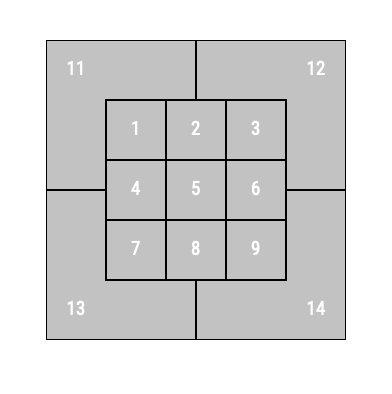
First I looked at where the pitchers are throwing the baseball in two strike counts.
| zone | count |
| 14 | 155 |
| 13 | 117 |
| 5 | 111 |
| 8 | 76 |
| 4 | 74 |
| 6 | 74 |
| 12 | 70 |
| 11 | 64 |
| 9 | 62 |
| 7 | 61 |
| 2 | 57 |
| 3 | 55 |
| 1 | 53 |
The top two zones are low and away/outside but shockingly third and fourth on this list are middle/middle and middle/down. Pitching in the heart of the plate is obviously not good, and a pitch being down goes right into the swing path of a hitter in this launch angle revolution.
Here is how things look on an 0-2 count:
| zone | count |
| 14 | 53 |
| 13 | 22 |
| 4 | 20 |
| 6 | 15 |
| 7 | 15 |
| 12 | 15 |
| 5 | 13 |
| 9 | 12 |
| 2 | 10 |
| 3 | 10 |
| 8 | 10 |
| 11 | 10 |
| 1 | 7 |
The first two are the exact same as two strike counts so it seems the philosophy is to try to get a hitter to swing and miss something down low. Though middle/middle (zone 5) isn’t third here, 4 & 6 are middle/in or out.
Unsurprisingly, with two strikes the hits are mostly when the location is zone 5 but on 0-2 it is zone 14. Seemingly the ball is not getting down enough in zone 14.
Pitch Type
Now let’s look at pitch type in two strike counts.
| pitch_type | count |
| FF | 269 |
| SL | 250 |
| CH | 239 |
| ST | 100 |
| CU | 55 |
| FC | 45 |
| FS | 35 |
| SI | 32 |
| KC | 4 |
So in a two strike count they are throwing a four-seam fastball the most followed by the slider.
Let’s look at 0-2
| pitch_type | count |
| FF | 52 |
| SL | 50 |
| CH | 47 |
| ST | 24 |
| CU | 13 |
| FS | 11 |
| FC | 8 |
| SI | 6 |
| KC | 1 |
Similar story here, with four seam fastballs being thrown the most. The majority of hits on 0-2 are sliders followed by the four-seam fastball.
Pitch Type + Location
We’ve looked at pitch type and location separately but now let’s slice the data by both (looking at the top 10), starting with two strikes.
| pitch_type | zone | count |
| CH | 14 | 55 |
| SL | 14 | 42 |
| FF | 11 | 41 |
| SL | 13 | 40 |
| CH | 13 | 36 |
| FF | 5 | 35 |
| ST | 14 | 34 |
| FF | 12 | 32 |
| CH | 8 | 31 |
| FF | 2 | 31 |
There is a clear trend here of throwing a changeup or slider down in the zone an a fastball up/in or outside. However, 35 pitches were middle/middle four seam fastballs!
Let’s look at 0-2
| pitch_type | zone | count |
| CH | 14 | 18 |
| SL | 14 | 14 |
| ST | 14 | 12 |
| SL | 13 | 10 |
| FF | 12 | 9 |
| FF | 3 | 8 |
| FF | 4 | 7 |
| FF | 11 | 7 |
| CH | 8 | 6 |
| CH | 13 | 6 |
Similar story here but no middle/middle fastball. Interestingly, the slider and changeup low/outside or inside resulted in the most hits on 0-2
Visualizing Two-Strike Hits
Lastly, let’s take a look at the location of two strike hits.
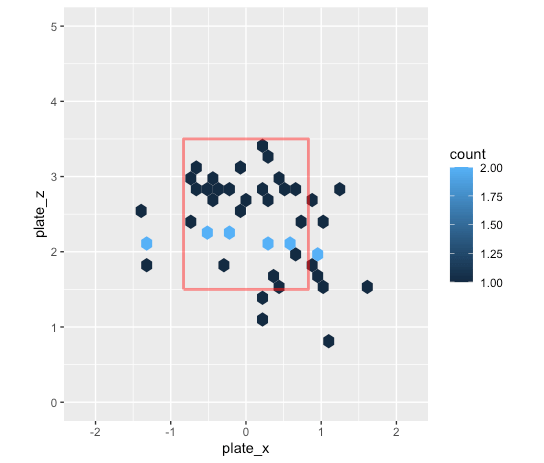
Of course the middle of the plate is showing up the most, but a large majority are in the strike zone, and if they aren’t they are close to the strike zone.
Conclusion
So what does this all mean? Unsurprisingly, middle/middle fastballs and sliders are punished but there is a clear pitching philosophy to get hitters out down in the zone rather than up in the zone. This leads to a higher possibility of bloop hits with higher launch angles. A confounding variable here is pitch sequencing, which could be an issue as well but beyond the scope of this post. I am no pitching coach but I think the Angels need to try to get hitters out more up with the fastball and also get the ball lower or more lateral movement out of the strike zone.
It will come down to execution, and I hope they can turn this around.

